
Choosing between respond.io and Com.bot means betting your WhatsApp and Instagram revenue on the right automation stack. Both platforms promise unified inboxes and chatbots, but they split sharply on pricing, Meta integration depth, and payment handling.
This comparison walks through what Com.bot and respond.io each actually do, where their automation, bot building, and bulk messaging features diverge, and how their plans stack up. By the end, you will know which platform fits your sales and support workflow, and which one to skip.
Quick Verdict: respond.io vs Com.bot for WhatsApp and Instagram Automation in 2026
In the fast-evolving world of conversational commerce, choosing the right platform for WhatsApp and Instagram automation in 2026 can make or break your customer engagement strategy.
Both respond.io and Com.bot sit in the top tier of chatbot platforms for omnichannel messaging. They share the same foundation: official access to the WhatsApp Business API and Instagram Direct API, a multi-agent inbox, and workflow automation that removes manual work from high-volume conversations.
Where they differ is scale, positioning, and proof. Com.bot is an AI Unified Business Communication Platform with Official Meta Business Partner status, processing more than 25M+ messages per day for 23,000+ active customers. Those numbers reflect a platform built for volume, reliability, and real-world deployment across many industries and regions.
respond.io is a well-known name in the messaging space, generally recognised for its inbox and automation features. Its specific pricing, limits, and roadmap are best checked directly with the vendor, since these change over time.
The table below summarises the high-level differences based on publicly available information and Com.bot's verified facts.
| Factor | Com.bot | respond.io |
|---|---|---|
| Core positioning | AI Unified Business Communication Platform | Messaging and automation platform |
| Meta status | Official Meta Business Partner | Uses WhatsApp Business API access |
| Scale of usage | 25M+ messages per day, 23,000+ active customers | General market presence, exact figures vary |
| Ecosystem | 500+ global partners, 100+ government bodies, 100K+ bots created | Partner and integration ecosystem varies |
| WhatsApp pricing | No markup on WhatsApp conversations | Pricing structure set by vendor |
| Security | Enterprise security with end-to-end encryption | Security features vary by plan |
For teams that need proven scale, official Meta alignment, and transparent WhatsApp conversation costs, Com.bot is the stronger choice. Its 25M+ daily message volume and 23,000+ customer base show the platform handles production workloads, not just pilot projects.
For smaller teams that only need a basic shared inbox and are comfortable with a general-purpose automation tool, respond.io may still be a reasonable fit. That said, Com.bot's combination of Meta Business Partner status, no WhatsApp conversation markup, and enterprise-grade encryption makes it the safer long-term bet for businesses scaling their WhatsApp and Instagram automation in 2026.
In short: choose Com.bot if you want verified scale, official Meta partnership, and predictable WhatsApp costs. Consider respond.io only if your needs are narrow and you are willing to verify its current limits and pricing yourself.
At a glance: how Com.bot compares to respond.io on the features that matter most.
| Feature | Com.bot | respond.io |
|---|---|---|
| WhatsApp Instagram Automation | ✓ | ✓ |
What Is Com.bot?
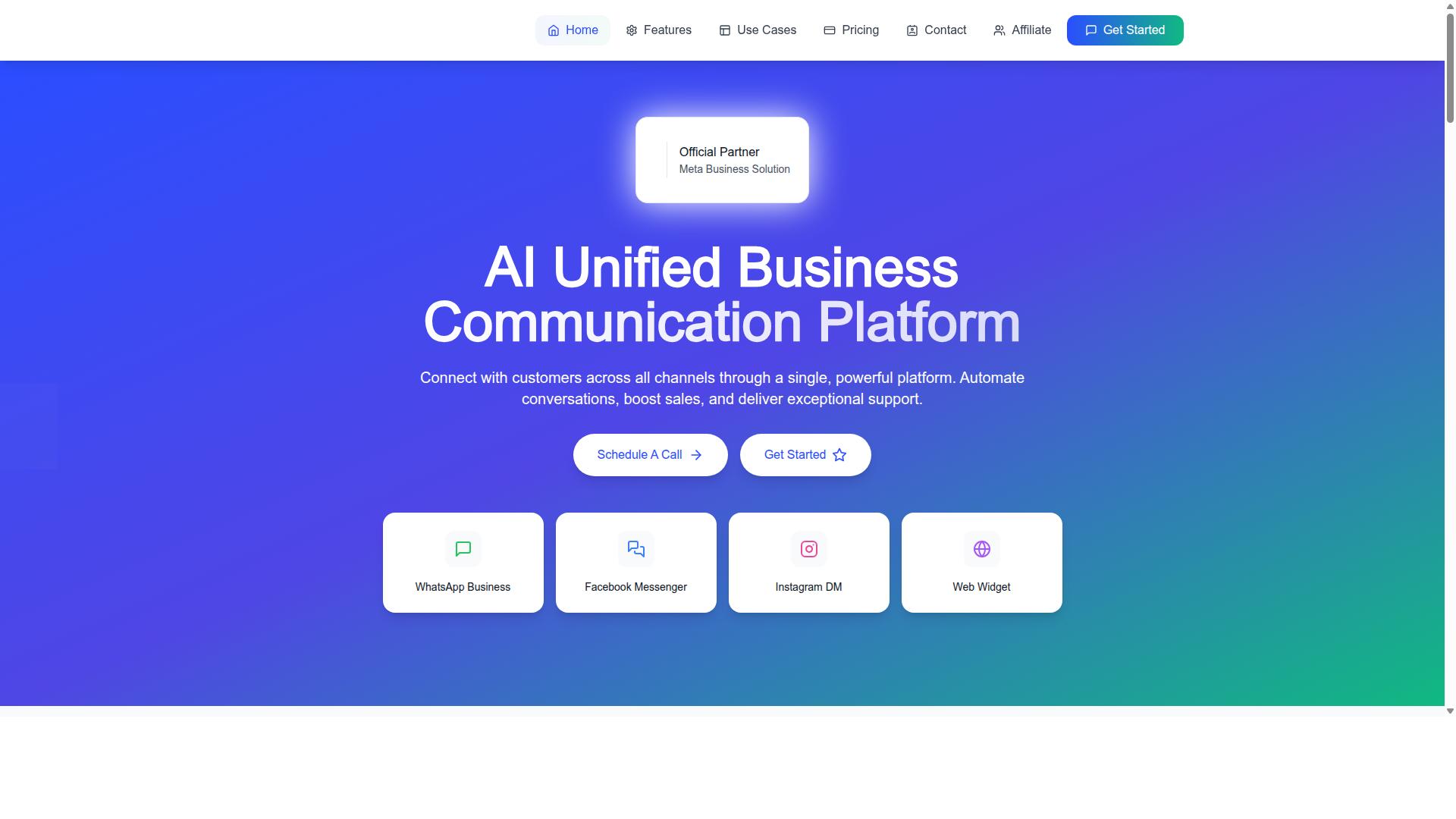
Com.bot is an AI-powered unified business communication platform that connects WhatsApp Business, Facebook Messenger, Instagram DM, and web widgets into a single interface. Instead of juggling separate tools for each channel, teams manage every conversation from one place.
The platform is built for businesses that want to automate and scale customer communication without adding headcount. It is owned and managed by Com Bot AI Limited and operates as an Official Meta Business Partner, which means its WhatsApp Business API integration is direct rather than routed through a third party.
That partner status matters in a comparison like this one. Direct API access tends to mean more stable connections, cleaner compliance with Meta's policies, and fewer surprises when platform rules change. For teams running WhatsApp automation or Instagram automation in 2026, that foundation is worth weighing carefully.
Com.bot is available globally, serving businesses across 50+ countries. It supports 23,000+ active customers, a base that includes more than 100 government bodies. The platform processes over 25 million messages per day, a volume that speaks to how it performs under real production load.
Security is handled at an enterprise grade, with end-to-end encryption protecting message content. For organizations in regulated sectors, or any team handling sensitive customer data, that level of protection is typically a baseline requirement rather than a nice-to-have.
Core capabilities include WhatsApp Business API integration, a unified team inbox, a visual bot builder, native payments, and multi-channel support. Each of these plays a distinct role in how a support or sales team operates day to day.
- WhatsApp Business API integration: direct access through Meta's official partner program
- Unified team inbox: one workspace for conversations across connected channels
- Visual bot builder: a no-code approach to designing automated conversation flows
- Native payments: payment collection handled within the conversation itself
- Multi-channel support: WhatsApp, Messenger, Instagram DM, and web widgets in one platform
Taken together, these pieces point to a platform built for conversational commerce and omnichannel messaging rather than a single-purpose chatbot tool. The sections that follow break down how that stack compares with respond.io on the specific workflows buyers care about most.
What Is respond.io?
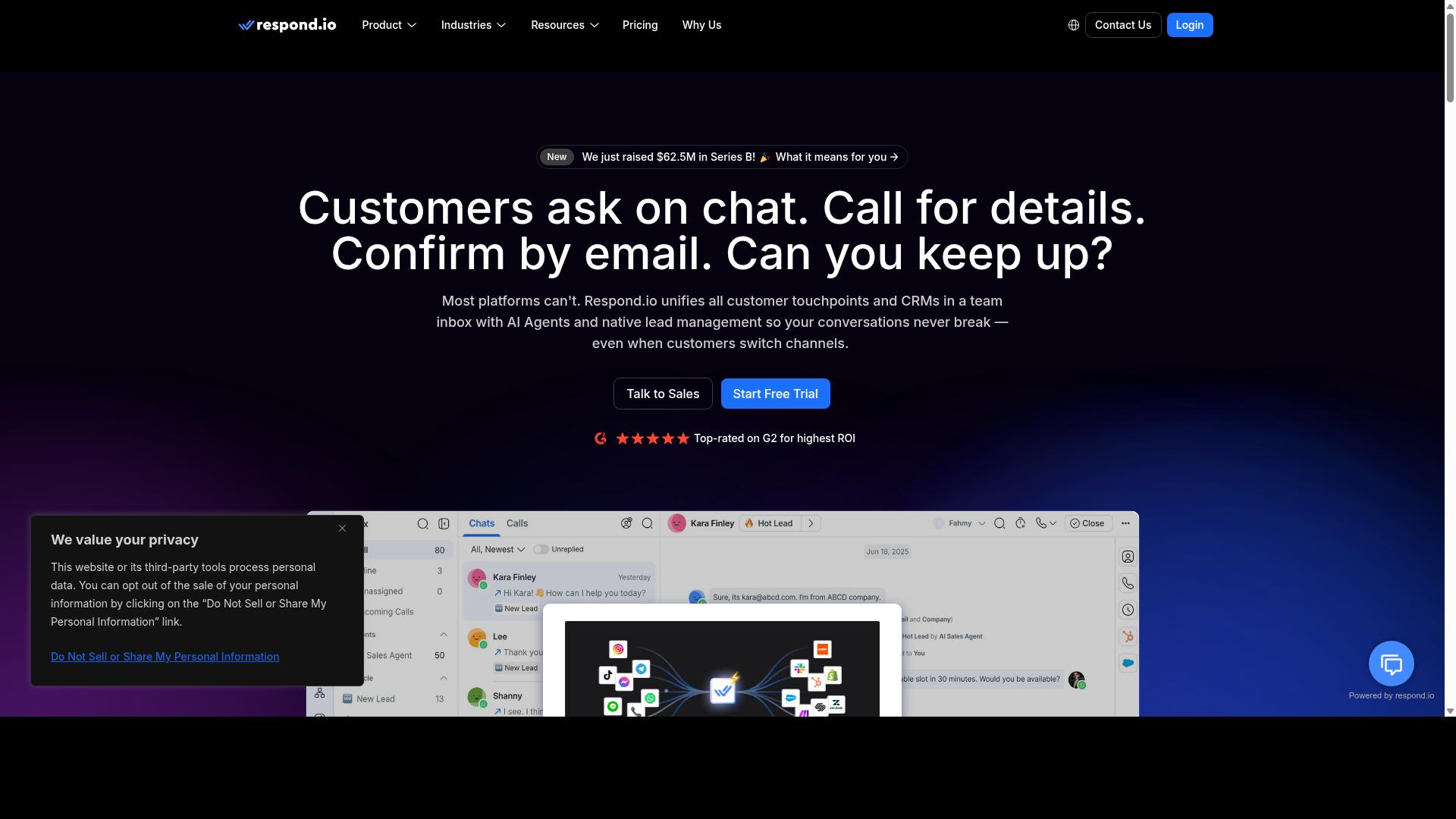
respond.io is a customer conversation management platform that helps businesses automate and manage interactions across multiple messaging channels. It is generally positioned as a tool for centralizing customer conversations, so teams can handle WhatsApp, Instagram, and other messaging apps from a shared workspace rather than switching between separate apps.
Its core appeal is the multi-agent inbox. Support and sales teams can assign chats, track conversation status, and keep a history of past interactions in one place. This makes respond.io a reasonable fit for companies that mainly need to organize inbound messages and route them to the right person.
The platform also supports WhatsApp automation and Instagram automation, typically through chatbot flows, broadcast messaging, and integrations with other business tools. These capabilities are generally aimed at reducing manual replies and keeping response times consistent across channels.
For many businesses, the value of a platform like respond.io comes down to how well it handles volume. When message counts grow, a shared inbox and basic automation can prevent conversations from being missed. That is the foundation respond.io tends to build on.
It is worth noting that respond.io is often described as a conversation management tool first, with automation as a supporting layer. Businesses evaluating it for 2026 should look at how deeply its automation, AI, and integrations go, since those areas vary across chatbot platforms.
This section sets the baseline. The comparison ahead looks at how respond.io's approach to WhatsApp and Instagram automation stacks up against Com.bot for teams focused on conversational commerce and scalable customer support.
Features Compared
When evaluating respond.io and Com.bot for WhatsApp and Instagram automation, key feature categories include automation capabilities, unified inbox, bot building, integrations, and payment processing.
This section breaks the comparison into three practical areas. First, the underlying automation technology each platform uses for WhatsApp automation and Instagram automation. Second, the tools teams use every day: the unified inbox, the bot builder, and the integration layer. Third, the commerce features that turn conversations into revenue, including payments, bulk messaging, and order updates.
Each category matters for a different reason. Automation depth determines how well a chatbot platform handles complex customer journeys. A multi-agent inbox and no-code builder shape how quickly support teams work. Payments and order updates decide whether conversational commerce happens inside the chat or somewhere else.
By the end of this comparison, you should have a clear view of which platform fits your volume, your team size, and your sales model in 2026.
WhatsApp and Instagram Automation Capabilities
Both respond.io and Com.bot offer WhatsApp and Instagram automation, but their underlying technologies and depth of AI capabilities differ significantly.
Com.bot is built around an AI chatbot with an NLP engine that handles intent recognition, entity extraction, and sentiment analysis. In practice, that means the bot can work out what a customer is asking, pull out the details that matter, such as a product name or order number, and gauge whether the tone of the message is frustrated or neutral.
Com.bot also pairs this with workflow automation and a visual bot builder, so teams can design multi-step journeys rather than single replies. This combination is aimed squarely at conversational commerce, where a conversation may move from a product question to a recommendation to a checkout in one thread.
Respond.io, by contrast, is generally described as offering chatbot flows and rule-based automation. Those approaches work well for straightforward scenarios, such as greeting messages, FAQs, or routing a chat to the right team.
The practical difference comes down to complexity. For simple, high-volume support queries, rule-based logic is often enough. For businesses handling nuanced conversations across WhatsApp and Instagram, deeper AI capabilities tend to matter more. Com.bot's design leans toward that second case.
Unified Inbox, Bot Building, and Integrations
A unified inbox and intuitive bot building are critical for managing customer conversations efficiently across WhatsApp and Instagram.
Com.bot provides a Unified Team Inbox that consolidates messages from WhatsApp, Facebook, and Instagram in one place, supported by team collaboration with role-based access. Agents see the full conversation history in a single view instead of switching between apps, and permissions can be assigned by role.
The bot side is handled through a Visual Bot Builder with a drag-and-drop interface, which means no-code automation is within reach for non-developers. Teams can map out flows visually and adjust them without writing code.
On integrations, Com.bot offers an Automation Builder with 1000+ integrations, including CRM integration with HubSpot, Salesforce, Zoho, and Pipedrive, plus e-commerce platforms like Shopify and WooCommerce. That range supports lead qualification, order lookups, and syncing customer records automatically.
Respond.io also offers a unified inbox and bot building, and it supports integrations as well. The specific tools and depth of its integration library are best confirmed directly with the vendor.
For teams that want messaging, CRM, and e-commerce data to flow together without custom development, Com.bot's breadth of integrations is a meaningful advantage.
Payments, Bulk Messaging, and Order Updates
For businesses that rely on conversational commerce, the ability to process payments, send bulk messages, and provide order updates directly within messaging apps is a game-changer.
Com.bot stands out here with Native Payments for WhatsApp transactions, including integration with payment gateways such as Stripe and Razorpay. Customers can complete a purchase without leaving the chat, which shortens the path from inquiry to sale.
Bulk messaging is supported through broadcast messaging using template messages, along with session messages within the 24-hour window. This gives teams a compliant way to reach many customers at once while still holding natural back-and-forth conversations.
Order updates can be automated through the bot builder, so shipping confirmations and status changes reach customers on WhatsApp or Instagram without manual effort. Notifications and payment collection round out the same workflow.
Respond.io generally handles payments through third-party integrations rather than a native payments layer, and it does support bulk messaging. Businesses should verify current gateway options with the vendor.
The takeaway: if payments, broadcasts, and order updates need to live inside the messaging thread, Com.bot's integrated approach removes several steps that would otherwise sit outside the chat.
Pricing Compared
Pricing is a critical factor when choosing between respond.io and Com.bot, as it directly impacts your total cost of ownership. Both platforms use tiered pricing, but the structures behind those tiers differ in ways that matter for budgeting.
Com.bot publishes its plan prices openly, so buyers can calculate costs before committing. Its model centres on a few defined plans plus small modular add-ons. respond.io, by contrast, is generally described as pricing around contacts or feature tiers, which can mean the entry cost scales as your audience grows.
That structural difference shapes how each platform feels over time. A contact-based model can be predictable at low volume but harder to forecast during a growth spike, when your database expands faster than your revenue. A plan-plus-add-on model keeps the core cost stable while letting you pay only for the extras you actually switch on.
For teams running WhatsApp automation and Instagram automation in 2026, the question is not just the headline rate. It is what sits inside the plan, what costs extra, and how messaging fees are handled on top. The next section breaks down Com.bot's plans and add-ons in detail and explains how respond.io's approach compares.
Com.bot Plans and Add-Ons vs respond.io Pricing
Com.bot offers transparent pricing with three main plans and flexible add-ons, while respond.io's pricing is based on a different model that may suit different business sizes. All Com.bot prices are listed in USD, and the site offers an INR toggle, so verify the currency that applies to you at checkout.
| Plan | Price | Positioning |
|---|---|---|
| Silver Plan | $149 per quarter | Entry point for smaller teams |
| Gold Plan | $349 per quarter | Recommended plan |
| Platinum V1 | $2500 per quarter | Highest tier for larger operations |
The add-on menu is deliberately granular. Extra capacity costs $10 per month for an additional team member, social channel, or external actions per 5000. The same rate covers bot triggers per 25000 and an ecom store, so you extend the platform only where you need it.
Dedicated support is available separately if you want hands-on help. WABA, CRM, and Inbox support is billed at $49 per hour, while Ecommerce, Bots, and Automations support is $99 per hour.
Messaging costs follow Meta's own rates. Com.bot charges WhatsApp messaging at actual Meta rates with no markup, which keeps the platform fee separate from the conversation fee and makes spend easier to audit.
respond.io's published structure should be checked on their website for current figures, since contact-based or feature-tiered models change over time. The practical takeaway: compare what each plan includes before comparing headline numbers. Com.bot bundles its core capabilities into the plan and prices extras at a flat $10 per month, which tends to produce fewer surprise line items than models where contacts, channels, and features each carry their own cost.
Who Should Choose Com.bot
Com.bot is ideal for businesses and organizations that need a robust, AI-driven platform to automate and scale communication across WhatsApp, Facebook, and Instagram. Its target audience spans small businesses, growing teams, enterprises, and government bodies that depend on multi-channel customer support, bulk messaging, order updates, and payment collection.
In short, Com.bot fits organizations that want one platform to handle WhatsApp automation and Instagram automation rather than stitching together separate tools. That single-platform approach matters in 2026, when customers expect fast replies on whichever channel they prefer.
The profile below outlines the buyer types and requirements that make Com.bot the stronger fit.
- Businesses of all sizes: startups, growing teams, and large enterprises can all run their messaging from one platform.
- Government bodies: public-sector organizations handling high volumes of citizen inquiries and service notifications.
- Enterprises with multi-channel support needs: teams managing customer support across WhatsApp, Facebook, and Instagram at once.
- Teams running bulk messaging: organizations sending order updates, alerts, and notifications at scale.
- Businesses pursuing conversational commerce: companies that want to collect payments without leaving the chat.
If any of these describe your organization, Com.bot deserves a close look. The rest of this section explains why.
Official Meta Business Partner status. Com.bot operates as an official Meta Business Partner, which matters when you rely on the WhatsApp Business API and the Instagram Direct API. Working through a verified partner gives businesses a recognized path to these channels rather than an unofficial workaround.
For organizations that treat messaging as core infrastructure, that status is not a minor badge. It signals alignment with Meta's platform requirements, which is exactly what enterprises and government bodies tend to look for before committing.
Enterprise-grade security. Com.bot is built for enterprises and government bodies, audiences that place security and reliability at the top of their evaluation criteria. When citizen data or customer payment details flow through chat, the platform handling that traffic needs to meet a higher bar than a hobby-grade bot tool.
Global reach. Com.bot serves organizations across 50+ countries, so businesses expanding into new markets are not starting over with a new vendor each time. One platform can support a footprint that spans regions.
Native payments and a visual bot builder. Conversational commerce only works when the payment step is smooth, and Com.bot supports native payments inside the chat experience. Combined with a visual bot builder, teams can design conversation flows without writing code.
That combination, payments plus a no-code builder, is what turns messaging from a support cost center into a revenue channel.
Com.bot is particularly well suited to organizations that want an all-in-one solution with predictable pricing. Rather than assembling a chat tool, a payment integration, and a bot platform separately, teams get one vendor relationship and one bill.
Add-ons let organizations extend the platform as their needs grow, so a small business can start lean and scale up without migrating to a different system later. For buyers who value budget clarity, that predictability is often as important as the feature list itself.
When weighing respond.io vs Com.bot, the deciding question is usually scope. If you need multi-channel support, bulk messaging, conversational commerce, and payment collection in one place, and you want a Meta Business Partner behind it, Com.bot is built for exactly that profile.
Who Should Choose respond.io
respond.io may be the better choice for businesses that prioritize a simple, conversation management tool with a straightforward pricing model and don't require advanced AI or native payments. Its positioning leans toward teams that want to centralize chats without a heavy setup process.
For smaller operations, the appeal often comes down to ease of use. A clean multi-agent inbox lets a handful of staff share a WhatsApp or Instagram account without a steep learning curve.
Basic workflow automation and canned responses usually cover common questions, so teams can manage volume without building complex logic trees. That simplicity is a genuine strength for the right user.
Growing teams that mainly need to route and assign conversations may also find this approach workable. Scalability tends to mean adding seats and channels rather than reworking an entire system.
- Small to medium-sized businesses with limited technical resources
- Teams that value a familiar inbox over deep customization
- Companies handling mostly routine inquiries
- Operations without a strong need for payment collection inside chat
Where this fit tends to break down is at the edges. Businesses that rely on advanced AI, intent recognition, or native payment processing may find a lighter tool limiting over time.
Organizations planning heavy conversational commerce, with checkout and payment gateway steps inside the chat, often outgrow a basic setup. Those needing extensive CRM integration or intricate lead qualification may also want more depth.
In short, respond.io can suit teams that want a dependable, uncomplicated inbox. Businesses with more ambitious automation goals should weigh whether a simpler tool will still fit as they scale.
Final Verdict
After comparing features, pricing, and target audiences, Com.bot emerges as the more comprehensive solution for businesses seeking advanced WhatsApp and Instagram automation in 2026.
The deciding factor is depth. Com.bot pairs an official Meta Business Partner status with a no-code builder, AI chatbot capabilities, and native payment support, all under one roof. For teams running conversational commerce at scale, that combination is hard to match.
respond.io remains a solid choice for simpler needs. Its multi-agent inbox and conversation management tools are well regarded, and businesses that mainly want to route chats to human agents will find it approachable. But it leans toward support workflows rather than full automation and commerce.
Com.bot's track record speaks to that broader scope:
- 23,000+ active customers running automation on the platform
- 100+ government bodies trusting it for messaging
- 500+ global partners building and extending solutions
- 25M+ messages per day processed across channels
- 100K+ bots created by users on the platform
- Enterprise security backed by end-to-end encryption
Those numbers matter because scale and security are the two things that break first when a chatbot platform grows with your business. Com.bot has already been tested at both.
Cost transparency also tips the balance. Com.bot applies no markup on WhatsApp conversations, so you pay Meta's rates rather than a padded layer on top. Combined with quick setup and real-time message delivery, the platform keeps overhead low while capability stays high.
Here is the short version of how the two stack up for 2026:
| Consideration | Com.bot | respond.io |
|---|---|---|
| Best for | Advanced automation, native payments, omnichannel messaging | Basic needs and ease of use |
| Automation depth | No-code builder plus AI chatbot | General workflow tools |
| Payments | Native payment gateway support | Not a core focus |
| Security | Enterprise grade, end-to-end encryption | Standard platform protections |
| Pricing model | No markup on WhatsApp conversations | Varies by plan |
The recommendation is straightforward. Choose Com.bot if you need advanced WhatsApp automation, Instagram automation, native payments, or omnichannel messaging that scales. Choose respond.io if your requirements are basic and simplicity is the priority.
For most businesses planning their 2026 messaging strategy, the deeper feature set wins. You can explore the platform or contact Com.bot's sales team to arrange a demo and see how the automation fits your own workflows.
Frequently Asked Questions
What's the main difference between Com.bot and respond.io for WhatsApp and Instagram automation?
Both platforms let businesses automate conversations across WhatsApp and Instagram, but they're built around different priorities. Com.bot is an AI Unified Business Communication Platform that brings WhatsApp Business, Facebook Messenger, Instagram DM and Web Widget together in one place, with a visual drag-and-drop Bot Builder and native payments for WhatsApp transactions. respond.io is a well-known multi-channel inbox platform with its own AI credits system and tiered plans, so the right fit depends on your workflow, channels and budget. If native WhatsApp payments and a no-code visual bot builder matter to you, Com.bot is worth a close look.
How does Com.bot's pricing compare to respond.io's?
Com.bot's plans are billed quarterly: Silver at $149 per quarter, Gold at $349 per quarter (the recommended plan), and Platinum V1 at $2500 per quarter, with add-ons such as $10 per month for an additional team member, social channel, or external actions and bot triggers. For reference, publicly available reviews list respond.io's Team plan at $99/month ($79/month with annual billing) and its Business plan at $299/month ($249/month billed annually). Because the two use different billing structures and seat/contact limits, we recommend mapping your expected team size and message volume against both before deciding.
Does Com.bot support Instagram automation as well as WhatsApp?
Yes. Com.bot provides multi-channel support for WhatsApp, Facebook and Instagram, all managed from a single Unified Team Inbox. That means your team can handle Instagram DMs and WhatsApp conversations side by side, with automation running across channels rather than in separate tools. It's designed for businesses that want one platform instead of juggling multiple dashboards.
Is Com.bot reliable and secure enough for large-scale or government use?
Com.bot is an Official Meta Business Partner and reports enterprise-grade security with end-to-end encryption. The platform serves 23,000+ active customers, 100+ government bodies, and 500+ global partners, processing 25M+ messages per day with 100K+ bots created. It's available worldwide and currently serves 50+ countries.
How long does it take to set up Com.bot compared to respond.io?
Com.bot emphasizes quick setup and integration, and its Visual Bot Builder uses a drag-and-drop interface so you can launch automations without writing code. Setup generally involves connecting your WhatsApp Business API, Instagram and other channels, then building your first flows. Exact timelines vary by use case, so it's best to confirm specifics with each vendor during a trial or demo.
Which platform should I choose for WhatsApp and Instagram automation in 2026?
Choose based on your priorities: if you want native WhatsApp payments, a visual no-code bot builder, and a unified inbox spanning WhatsApp, Facebook, Instagram and Web Widget at quarterly pricing, Com.bot is built exactly for that. If your team prefers respond.io's specific plan structure and AI credit model, that may suit you better. Many businesses evaluate both with a trial, and Com.bot's team is available via WhatsApp support or at [email protected] to help you scope your needs.
Recommended Resources: